
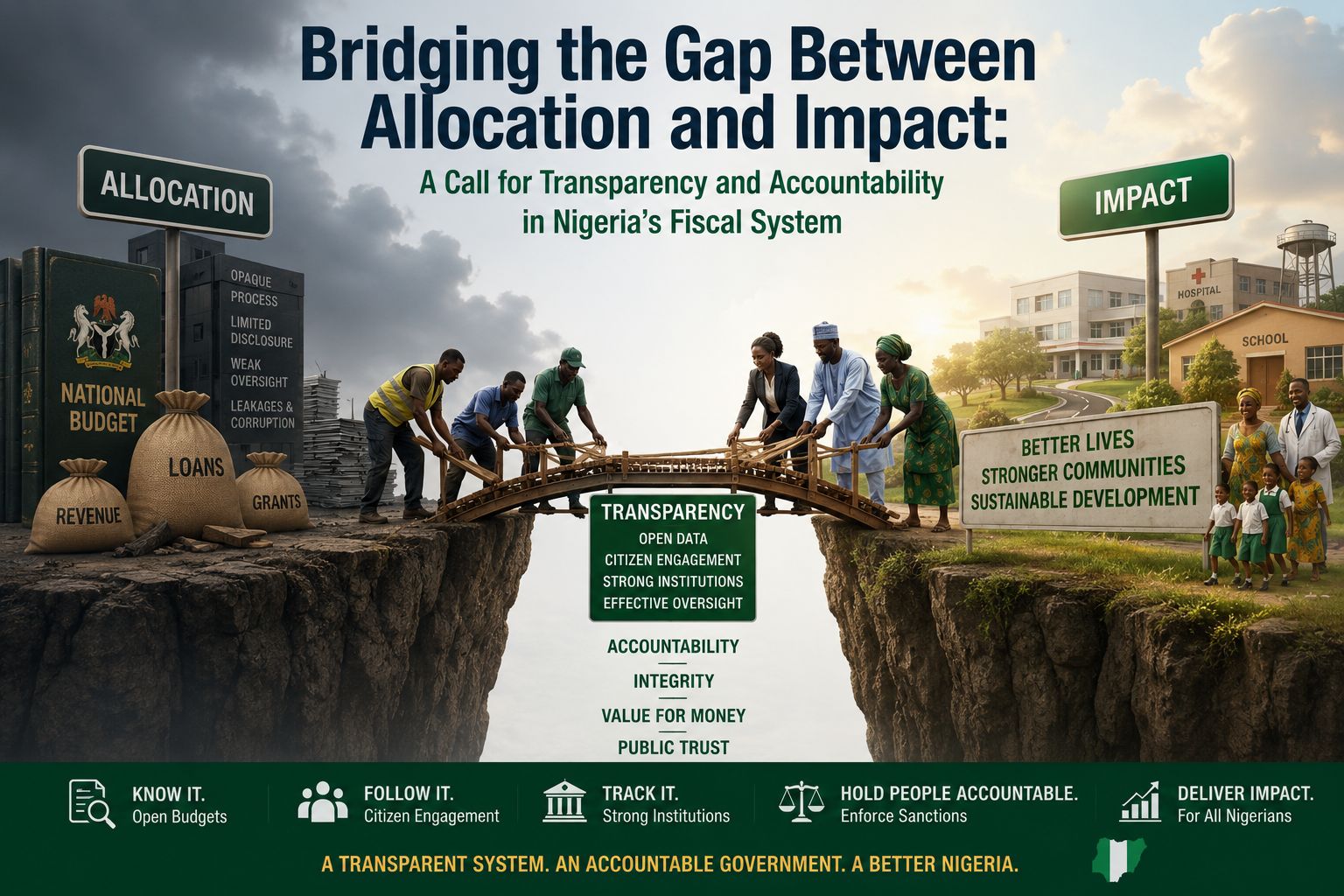
Bridging the Gap Between Allocation and Impact: A Call for Transparency and Accountability in Nigeria’s Fiscal System

The Revenue Mobilization Allocation and Fiscal Commission (RMAFC), a constitutionally established body in Nigeria, plays a pivotal role in the country’s fiscal architecture. Entrusted with the responsibility of monitoring accruals into the Federation Account, overseeing revenue disbursement, and determining the revenue-sharing formula among the federal, state, and local governments, RMAFC stands at the heart of Nigeria’s financial governance system.
In addition to these responsibilities, the Commission ensures equitable distribution of national resources, fixes the remuneration of political office holders, and provides advisory support on fiscal efficiency across all tiers of government. On paper, this framework is designed to ensure fairness, accountability, and development at the grassroots level.
However, for millions of ordinary Nigerians, especially those residing in local communities, the tangible benefits of these allocations remain largely invisible.
The Crisis: “The Allocation-Impact Disconnect”
Across the country, a growing concern is emerging—what can be described as “The Allocation-Impact Disconnect.” This term captures the widening gap between the substantial funds allocated to local governments from the Federation Account and the lack of visible development or improved living conditions experienced by citizens.
Despite consistent disbursements, many local governments continue to struggle with basic service delivery. Roads remain dilapidated, healthcare centers are under-equipped, schools lack essential infrastructure, and communities face persistent challenges in water supply and sanitation. For citizens, the question is simple: Where is the money going?
This disconnect has created a perception crisis, where the efforts of the federal government—particularly under the leadership of Bola Ahmed Tinubu—are not fully felt at the grassroots level. While federal policies and reforms may be well-intentioned, their impact is often diluted or completely lost by the time resources reach local authorities.
A One-Sided Experience of Governance
Many Nigerians today report experiencing only the negative aspects of governance—rising costs of living, economic adjustments, and policy shifts—without the corresponding benefits of improved infrastructure or social services.
This imbalance has fueled public frustration and eroded trust in government institutions. Citizens increasingly associate national policies with hardship, rather than progress, because the final link in the governance chain—the local government system—has largely failed to deliver.
Local government chairpersons, who are closest to the people and best positioned to respond to community needs, have not consistently fulfilled their mandates. In many cases, there is little transparency about how funds are utilized, limited communication with constituents, and minimal accountability for outcomes.
As a result, the Renewed Hope Agenda of the current administration risks being undermined, not by policy design, but by weak execution at the grassroots level.
The Missing Link: Transparency and Visibility
At the core of “The Allocation-Impact Disconnect” is a lack of transparency and real-time visibility into how public funds are being used. While allocations are publicly documented at the federal level, there is insufficient tracking of how these funds translate into projects, services, and outcomes within local communities.
Citizens are left in the dark. Even the federal government lacks an efficient, centralized mechanism to quickly assess the performance of individual local governments.
Without data, there can be no accountability. Without accountability, there can be no trust.
A Practical Solution: The RMAFC Executive Summary Dashboard
To address this challenge, it is proposed that RMAFC develops and deploys a National Executive Summary Dashboard—a digital transparency and monitoring tool designed to bridge the gap between allocation and impact.
This dashboard would provide a clear, accessible, and real-time overview of financial flows and project execution across all states and local governments in Nigeria.
Key Features of the Dashboard:
1. Monthly Allocation Breakdown
• Detailed records of how much each state and local government receives from the Federation Account.
2. Utilization Reports
• A summary of what each local government spent its allocation on in the previous month (e.g., road repairs, school renovations, healthcare improvements).
3. Forward Planning
• A preview of planned projects and initiatives for the upcoming month.
4. Performance Indicators
• Metrics to evaluate delivery efficiency, project completion rates, and community impact.
5. Public Accessibility
• A simplified version available to citizens, ensuring transparency and encouraging civic engagement.
6. Executive Oversight Capability
• A feature enabling the President and relevant federal authorities to select any local government and instantly review its financial and operational performance.
Empowering Leadership and Restoring Trust
With such a system in place, President Tinubu would have the ability to directly assess whether federal allocations are translating into meaningful development at the grassroots level. This aligns closely with the objectives of the Renewed Hope Agenda, ensuring that governance is not only policy-driven but results-oriented.
More importantly, the dashboard would serve as a powerful accountability tool. Local government chairpersons would be required to justify their spending and demonstrate measurable outcomes. Poor performance would be visible, and excellence could be recognized and replicated.
For citizens, this initiative would restore confidence in the system. When people can see how funds are allocated and used—and more importantly, when they can see real improvements in their communities—the narrative of governance begins to change.
A Call to Action
Nigeria stands at a critical juncture. The structures for equitable resource distribution already exist. The challenge now is ensuring that these resources translate into real, visible impact for the people.
RMAFC, given its constitutional mandate and strategic position, is uniquely placed to lead this transformation. By embracing technology, enhancing transparency, and strengthening accountability mechanisms, the Commission can play a central role in closing “The Allocation-Impact Disconnect.”
The time has come to move beyond allocation and focus on impact.
Because governance is not measured by how much is shared—but by how much is felt.